3 months ago|
Artificial intelligence
Agentic AI
Agentic AI
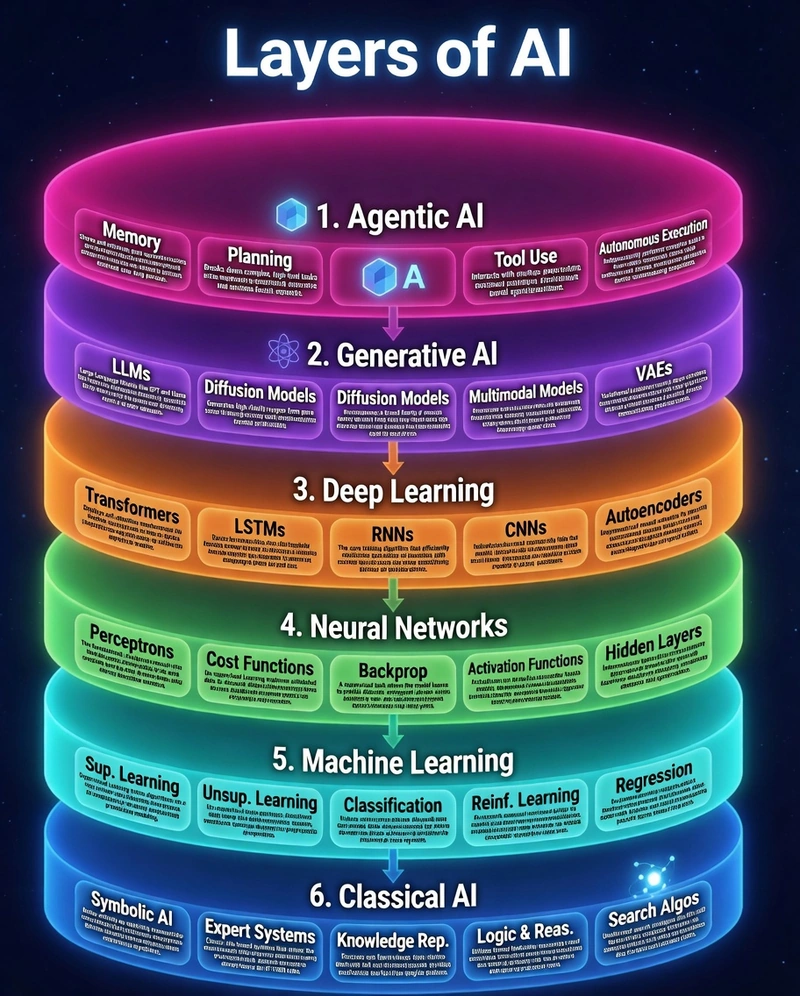
Moving Beyond One Agent: Multi-Agent Orchestration

The blueprint above outlines a single agent acting alone. But the true enterprise revolution happens when you build a digital department—a network of specialized agents working together. This is called Multi-Agent Orchestration.

In a mature n8n environment, you don’t just deploy an "AI Bot." You deploy an entire hierarchical ecosystem:

                  ┌──────────────────────┐
                  │  Master Orchestrator │
                  └──────────┬───────────┘
                             │
         ┌───────────────────┼───────────────────┐
         ▼                   ▼                   ▼
┌─────────────────┐ ┌─────────────────┐ ┌─────────────────┐
│ Lead Gen Agent  │ │ Copywriter Agent│ │ Reviewer Agent  │
└─────────────────┘ └─────────────────┘ └─────────────────┘


The Master Orchestrator: An LLM (like GPT-4o) tasked with analyzing incoming requests, breaking down the project, and delegating sub-tasks.

The Specialized Agents: One agent is optimized solely for scraping and data extraction; another is primed for writing high-conversion copy; a third acts as a "Peer Reviewer" to check the copy for formatting errors and brand alignment.

By compartmentalizing their jobs, you prevent the "context confusion" that happens when you ask a single AI to do too many things at once.

The Reality Check: Guardrails & Human-in-the-Loop

As exciting as full autonomy is, the tech industry has learned a vital lesson: Autopilot is great, but you still need a pilot in the cockpit.

If you unleash an agent with full access to your web browser or company credit card without boundaries, you risk infinite loops, bloated API bills, or worse—hallucinated actions that impact real customers.

When building agentic workflows, you must design with three defensive layers:

1. Human-in-the-Loop (HITL)

For high-stakes execution (like sending an email to a VIP client or moving data to a production database), use n8n’s native wait and approval nodes. The agent compiles the data and drafts the action, but pauses for a human to click "Approve" via Slack or an interactive dashboard before the final execution.

2. Deterministic Guardrails

Don't rely on the AI to follow text-based rules perfectly. Combine AI reasoning with strict, code-based conditions. For instance, use conditional nodes to verify that an AI-extracted email address actually contains an @ symbol before passing it to an email tool.

3. Cost and Time Bounds

Configure your agent nodes with a strict maximum iteration limit (e.g., "Stop after 5 tool calls"). This prevents an agent from getting stuck on a broken website and looping continuously, burning through your API credits while you sleep.

The Geopolitical Shift: The fragility of relying on single, centralized agent platforms was highlighted by the sudden corporate unwinding of Manus after its rapid multi-billion dollar acquisition. This shift has proven that enterprise data security demands platform-agnostic orchestration. By building your agentic logic inside a self-hosted platform like n8n, you control your data, your integrations, and your underlying models—switching from OpenAI to Anthropic or local open-source models with a single click.

How to Get Your Hands Dirty: Your 4-Step Checklist

Ready to build your first autonomous assistant? You don’t need a computer science degree to start. Here is how to map it out:

Step 1: Define the Brain. Set up an n8n workspace, add an Advanced AI Agent node, and link it to your foundation model of choice (e.g., Google Gemini, OpenAI, or Anthropic Claude). Keep the model's temperature low (around 0.2) to ensure precise, logical tool use.

Step 2: Provision the Senses. Give your agent tools. Start basic: connect a Web Search API (like SerpApi) and an HTTP Request node for scraping.

Step 3: Establish the Memory. Attach a Window Buffer Memory node to your agent. This ensures that when the agent is executing step 4 of a task, it still remembers the data it discovered in step 1.

Step 4: Prompt with Intent. Write a robust system prompt. Clearly outline its role, its constraints, the tools available to it, and the exact format you want for the final output.

Final Thoughts: The New Era of Work

We are moving away from a world where humans adapt to the constraints of rigid software, and entering an era where software dynamically adapts to human intent.

Whether you are using specialized multi-agent pipelines in n8n to automate enterprise operations, or leveraging general-purpose browser agents to handle open-ended research, the competitive advantage is shifting. The most valuable skill sets are moving away from manual execution and toward systems architecture and prompt engineering.

Stop prompting your AI. Start managing your agents.
You may also like

DTERMANISTIC AI MODEL WITH RAG
07 Jul, 2026
Fable 5 By anthropic is it too dangerous
16 Jun, 2026